Discover
Free comparison tool
Free · instant
Enter your budgets and see what changes in your costs. If you prefer to start from your sector averages, use the detailed simulator.
Compare now
BINÁ INDUSTRIAL · INDUSTRIAL EXPANSION IN PARAGUAY
We assess industrial costs, supply, logistics, market access, investment and risk to determine whether Paraguay makes sense for your operation.
Industrial engineering · Operations management · Corporate finance
MarketsOrigin and access conditions
LogisticsCosts, routes and lead times
LocationAt the heart of Mercosur
Regime and eligibility
assessed per project
Market access
subject to origin rules
Project Profile
in 5 business days*
Key variables
in your comparison
What we assess
Maquila is a tool, not the conclusion of the study. Whether it pays depends on six fronts, and we look at them together before recommending an investment.
People, energy, maintenance and overhead, for the same product and volume.
Where raw materials and inputs come from, what they cost and what duty they pay.
Freight, routes, lead times and what the product weighs in the cost of reaching the customer.
Origin rules, applicable regime and duty in each destination, product by product.
Initial capital, working capital, capital structure and scenarios to present to lenders.
Transition, rule changes, exchange rates and the cost of going back if something does not work.
Each step answers part of the question before you pay for the next. If the numbers do not work, we tell you and it ends there.
Free · instant
Enter your budgets and see what changes in your costs. If you prefer to start from your sector averages, use the detailed simulator.
Compare nowUSD 297 · 5 business days*
A pre-assessment with your company’s data that ends in a recommendation: go on or stop.
See what you receiveTailored · 20 to 30 business days
A financial model with scenarios, an origin opinion per product and a roadmap for your board. Quoted only if the Profile comes out green.
See a sample PDFFee per milestone met
A pilot before investing in a plant, company and regime, set-up and start-up, with the group companies in Paraguay.
Meet the groupDelivered in 5 business days from receipt of the complete questionnaire. If you go on to the Board-Ready Plan, the Profile fee is credited.
See a sample Profile (PDF)*Estimated from receipt of the complete questionnaire. Conditions are confirmed in writing when you engage us.
Who it is for
We would rather tell you before you spend. These are the signals we look at first, and the filter in the detailed simulator applies them to your case in one minute.
A first look at your project
Compare two operating budgets with your own figures: the calculation does not invent country advantages. If you prefer to start from your sector averages, use the detailed simulator.
Your assumptions compared
Complete both budgets to see the annual difference and its limits.
Example assumptions
A line with USD 10 million revenue a year · same product and volume · USD per year
| Item | Today | Paraguay |
|---|---|---|
| People | 1,800,000 | 1,250,000 |
| Energy | 400,000 | 260,000 |
| Logistics | 500,000 | 820,000 |
| Inputs | 5,200,000 | 5,150,000 |
| Structure and other | 700,000 | 870,000 |
Difference: USD 250,000 a year, 2.5% of the line’s revenue, before income tax.
Fictional values to explore the tool. They are not sector averages or verified costs for Paraguay.
Includes example assumptions. Review them and replace them with your company’s data.
This is an arithmetic comparison, not an investment recommendation. It excludes CAPEX, transition, financing and taxes. If your costs include them, say so when you request the analysis.
Maquila
What it is, what you pay and how inputs come in: the essentials before you look at numbers. It is a variable of the applicable regime, not proof of profitability.
Production or services under contract for foreign markets.
 1
The company that contracts the production or services.
 2
Goods are processed or assembled, or the service delivered, with local resources.
 3
Products or services go out to international markets.
You pay 1% on the larger of two amounts: national value added or the export invoice.
Local labour, inputs and services built into the process.
Total value of the goods exported under the programme.
The larger one counts
Tax base100
Tax (1%)1,0
Illustrative example per 100 of invoice. The base and the calculation are validated against current rules and the competent authority for each programme.
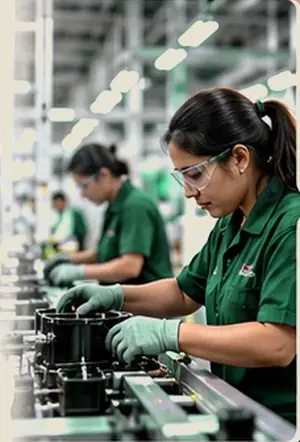
Authorised inputs and equipment enter with customs duties suspended, are processed in Paraguay and leave as finished goods.
 1
Raw materials, parts, components and inputs for production.
 2
Manufacturing, assembly or processing that adds value in the country.
 3
Finished goods ship to destination markets under the programme.
Source and review
Maquila Law 7547/2025 and its regulations, published by Paraguay’s Ministry of Industry and Trade. Page last reviewed: October 2026.
See the map of maquila companiesThe analysis depends on your product, your operation and your destination market.
Biná Shefa Group
Industrial engineering, business management and corporate finance in one team. When the analysis comes out green, the group companies cover finance, labour compliance and premises.
 Finance, accounting and maquila plans
 Labour and legal compliance
 Property, offices and premises
Not necessarily. You can compare one line, a new plant or extra capacity. The scope depends on your operation and your goal.
No. It depends on the product, volume, inputs, logistics, investment and applicable conditions. The analysis may also recommend not going ahead.
No. It tells you whether it is worth going deeper. If you go ahead, the fee is credited to the Board-Ready Plan, which is the full study.
Our work measures the economic effect. Licensed professionals in Brazil and Paraguay sign the legal and tax opinion.
Country, sector, goal and a rough idea of costs. Do not send financial statements or sensitive documents in the first form: study documents are agreed later.
The Project Profile costs USD 297 and is delivered in 5 business days from receipt of the complete questionnaire. The Board-Ready Plan and implementation are quoted in writing.
No. It compares the operating budgets you enter. Regime eligibility, origin rules and taxes need a specific review.
Each one is labelled. An illustrative exercise explains a tool with fictional figures. A feasibility study uses a company’s data and verifiable sources. A real case is published only with the client’s permission and verifiable data.
With the access link you received by email. If you need help, write to us by email or WhatsApp.
Let us talk about your next decision
Share the context of your project and we will discuss the analysis you need. You do not need to share confidential information in this first contact.
Write by emailcontact@binashefa.com ↗Talk on WhatsApp+595 993 081 774 ↗Asunción, Paraguay
Are you a Paraguayan small business that wants to sell to industry? Meet Biná Mipymes